
品詞の分類
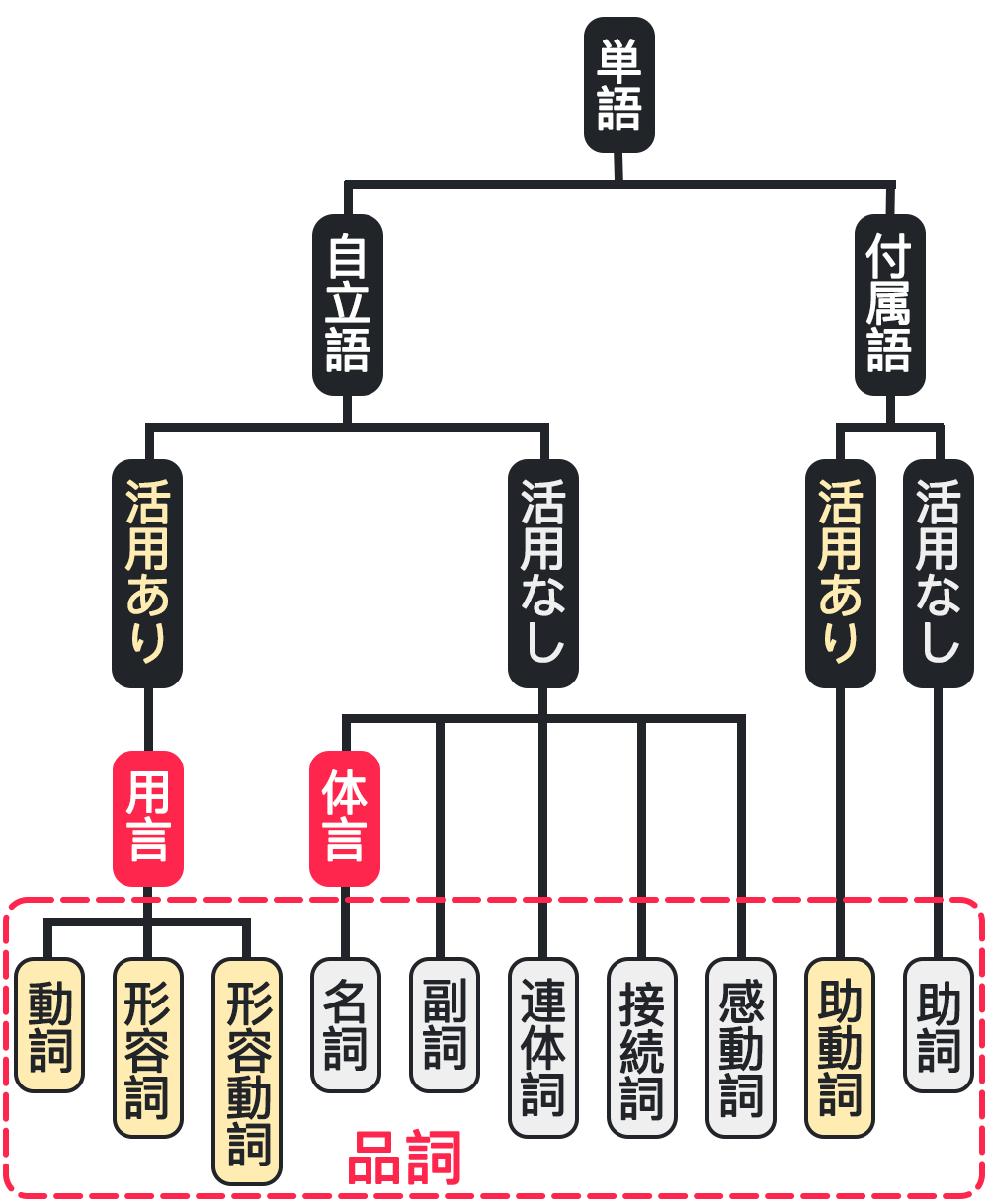
品詞は、文法上の性質や働きによって、単語を分類したものです。
品詞には、
動詞・形容詞・形容動詞
・名詞・副詞・連体詞
・接続詞・感動詞・助動詞・
助詞の10種類があります。
Parts of speech are the classification of words by their grammatical nature and function.
There are ten parts of speech: the verb, the i-adjective, the na-adjective, the noun, the adverb, the adnominal, the conjunction, the interjection, the auxiliary verb, and the particle.
動詞
動作や状態を表す単語を動詞といいます。辞書形がう段で終わります。活用がある自立語です。
A word that expresses an action or a state is called a verb. Its dictionary form ends in the う row of kana. It is an independent word that conjugates.
例
走る・食べる・書く
形容詞
人・物の様子や状態を表す単語を形容詞といいます。辞書形が「い」で終わります。教科書によって、「形容詞1」、「イ形容詞」ということもあります。活用がある自立語です。
A word that expresses the appearance or state of a person or thing is called an i-adjective. Its dictionary form ends in 「い」. Depending on the textbook, it is also called an 「Adjective 1」 or an 「i-adjective」. It is an independent word that conjugates.
例
面白い・楽しい・大きい
形容動詞
人・物の様子や状態を表す単語を形容動詞といいます。教科書によって、「形容詞2」、「ナ形容詞」ということもあります。活用がある自立語です。
A word that expresses the appearance or state of a person or thing is called a na-adjective. Depending on the textbook, it is also called an 「Adjective 2」 or a 「na-adjective」. It is an independent word that conjugates.
例
静かだ・親切だ・きれいだ
名詞
人や生き物・物の名称を表す単語を名詞といいます。主語になることができます。活用がない自立語です。
A word that names a person, a living thing, or an object is called a noun. It can become the subject. It is an independent word that does not conjugate.
例
猫・私・大阪
副詞
動詞・形容詞・形容動詞を詳しく説明する単語を副詞といいます。主に連用修飾語になります。活用がない自立語です。(連用修飾語は、用言を修飾する単語のことです。)
A word that gives a detailed account of a verb, an i-adjective, or a na-adjective is called an adverb. It mainly serves as an adverbial modifier. It is an independent word that does not conjugate.
例
とても・かなり・はっきり
連体詞
名詞を修飾する単語を連体詞といいます。主に連体修飾語になります。活用がない自立語です。(連体修飾語は、体言を修飾する単語のことです。)
A word that modifies a noun is called an adnominal. It mainly serves as an adnominal modifier. It is an independent word that does not conjugate.
例
大きな・この・あの
接続詞
文節と文節をつなげる単語を接続詞といいます。活用がない自立語です。
A word that connects one phrase to another is called a conjunction. It is an independent word that does not conjugate.
例
それで・しかし・だから
感動詞
感情や呼びかけ、あいさつを表す単語を感動詞といいます。独立語として使われます。活用がない自立語です。
A word that expresses emotion, a call, or a greeting is called an interjection. It is used as an independent element. It is an independent word that does not conjugate.
例
ああ・うん・おはよう
助動詞
主に文節や文の終わりにつき、様々な意味を加える単語を助動詞といいます。活用がある付属語です。
A word that attaches mainly to the end of a phrase or sentence and adds various meanings is called an auxiliary verb. It is an ancillary word that conjugates.
例
れる・られる・ない
助詞
言葉に意味を加える単語を助詞といいます。活用がない付属語です。
A word that adds meaning to other words is called a particle. It is an ancillary word that does not conjugate.
例
が・を・の
体言と用言
自立語で活用があるもの(動詞・形容詞・形容動詞)をまとめて用言といいます。
用言に対して、自立語で活用がないもの、かつ主語になれるもの(名詞)を体言といいます。
Independent words that conjugate (verbs, i-adjectives, and na-adjectives) are collectively called 「inflectable words」.
In contrast to inflectable words, independent words that do not conjugate but can become the subject (nouns) are called 「substantives」.
例文
今日、私は大きな日本語の学校に行きました。
解説
[体言] 今日・私・日本語・学校
[用言] 行き
品詞の転成
単語の品詞が変わることです。
This is when the part of speech of a word changes.
例文
❶ 会社を休み、旅行に行く。
❷ 今日は、休みの日です。
解説
❶の休みは動詞で、 ❷の休みは名詞です。(動詞の連用形 → 名詞)